TABLE OF CONTENTSSeries I: Emergency Farm Labor Correspondence, 1942-1948 Series II: Emergency Farm Labor Financial Records, undated, 1941-1948 Series III: Legislation, undated, 1942-1947 Series IV: Emergency Farm Labor Conferences, 1942-1947 Series V: Emergency Farm Labor Schematics, undated, 1943 Series VI: Emergency Farm Labor Marketing Material, undated, 1942-1949 Series VII: Reports, 1943-1948 Series VIII: Farm Labor, undated, 1939-1947 Series IX: Farm Labor Camp, undated, 1943-1947 Series X: Youth Labor Camps, undated, 1943-1947 Series XI: Women's Land Army, 1942-1945 Series XII: Extension Services, 1943 Series XIII: USDA Farm Survey Notes, undated, 1914-1943 Series XIV: State of Connecticut Farm Economics Agricultural Survey Series XV: Federal and State marketing surveys Series XVI: Connecticut Agricultural College, undated, 1920-1959 |
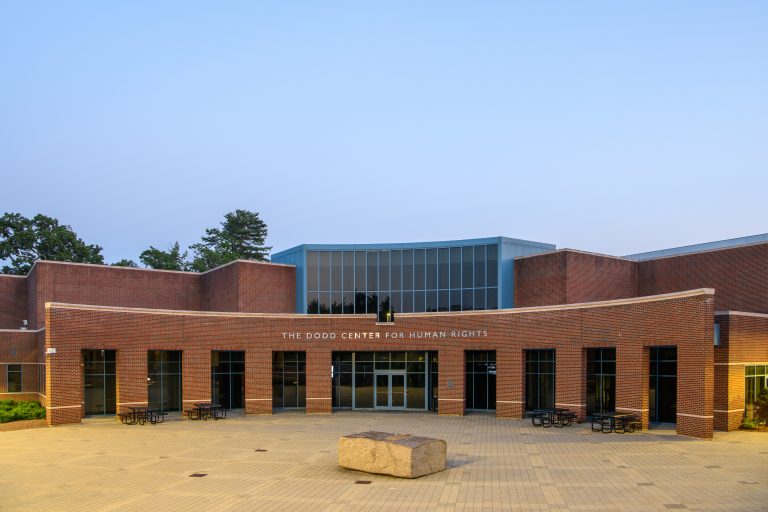
![]() University of Connecticut, Agricultural Economics Department RecordsArchives & Special Collections at the Thomas J. Dodd Center405 Babbidge Road, Unit 1205Storrs, Connecticut 06269-1205URL: http://doddcenter.uconn.edu/
HistoryThis Collection reflects the many bureaucratic permutations of the Agricultural Economics Department at the University of Connecticut from the late 1910s until after World War II. The Collection spans many institutional name changes and reorganizations. The University itself underwent three during this time period. In 1899, the institution was chartered as the Connecticut Agricultural College until 1933, when the name was changed to Connecticut State College. In 1939, the name was changed to the University of Connecticut. The documents reflect these name changes. The bulk of the collection is documentation from the Extension Service, which was headed by one of three Directors of the school, then known as Connecticut Agricultural College, with the President as the Executive head of the College. Under him were three Directors, the two others being the Faculty and the Director of Instruction, and the Director of the Experimental Station. The Extension Service, described in the College Bulletin as, "...the division of the college that carries on all of the non-resident educational work of the institution. Extension teaching is done through personal and circular letters, farm and home visits, bulletins, news and special articles, radio, meetings, classes, and in other ways" , was formalized in 1914. The Extension Service served the state, in the words of the State College Biennial Report: "As our agriculture becomes more intensive and competition becomes keener, the simple practices of the past must give place to highly technical methods of production and marketing. If Connecticut's farming is to continue prosperous, (sic) it will demand more and more research, and will not be satisfied with superficial work." This quote is a reference to the early 20th century trend toward the industrialization of agriculture, as well as the application of scientific methodology in order to maximize the economic benefits of farming. Farming had been a local economy that simultaneously sustained local families and brought in small local profits. When the war intervened, the Federal government found ways to turn local products into commodities that people could profit from, even when the commodity was not yet considered a staple of family life. For example, during World War I, an extension economist noted that, "Milk was the one surplus food in Connecticut and a campaign to induce children to drink more milk was instituted." The combination of Federal, State and County funding for the University Extension Service eventually resulted in a Cooperative Organization between the four groups. Initially, the Connecticut Agricultural College was given State and Federal funding to provide agricultural training to local farmers before and during World War I. These training networks were expanded upon during the war, and were firmly in place by the time of the Depression. According to the book, Connecticut Agricultural College - A History by Walter Stemmons, the combination of Federal and State funding helped to "extend...the college campus to the boundary of the state." The Extension service began as an outgrowth of the Cooperative orchard demonstrations held jointly by the College and the Connecticut Pomological Service. By 1915, Professor I.G. Davis became the Assistant State Leader of Extension Services, which was organized by county. Their marketing materials began with the Farm Bureau News, which became the Extension Service News, and was finally entitled the Connecticut Agricultural College (CAC) Review, with I.G. Davis serving as editor. The pre-World War I years saw the Extension Service set goals to professionalize agriculture. They began by chronicling markets, which were previously not monitored or quantified, "[I]n 1917 the Extension service, in cooperation with the United States Bureau of Markets and the Bridgeport fruit and vegetable association, established a daily reporting service on the Bridgeport market. These records are in the non-processed portion of the collection. The success of this plan led to its extension the following summer to Hartford, New Haven and Waterbury. Later the egg market was included in the reports. From this beginning developed a state-wide market reporting service." The Extension Service was responsible for other areas, such as field crops, sheep, animal husbandry, and bee-keeping. Records for these endeavors are not included in this collection, nor is farm/home engineering or forestry. However, fruit and vegetable surveys are included. In addition, there are Home Demonstration surveys, which have quantified the financial aspects of running a domestic economy. However, this Collection also includes handwritten notes from the surveyors themselves. These field agent notebooks give background information on some of the women surveyed, especially those reluctant to participate, "[s]he seems to delight in being pernicious." These records are in the non-processed portion of the collection. The First World War contributed to growth of the Extension Service, financially speaking, "What the war did was to speed up the machinery tremendously and to make available financial resources far beyond the expectancy of natural growth. It also provided contacts and elements of cooperation little short of impossible in peace time." Surveys were the method used to quantify agricultural production, as well poultry farms. In addition, farm management surveys were implemented, "During the first two years of the extension service about one thousand farm management records were taken in each of seven counties as a basis for the new county movement." Although the survey covers acres tilled, and livestock owned, there is, in addition, personal information such as nationality, education, and standard of living survey information which provides a revealing indication of how government judged quality of life. By 1925, the Director of the Extension Service, Mr. Ellis, described the interconnections between the then Connecticut Agricultural College (CAC), the local farming population, and the Federal government, "The Extension service is the division of the CAC which is extending information on improved methods in agriculture and home making to the rural population of the state. The extension service in Connecticut is a part of a National system of agricultural education established by federal laws." This seemingly altruistic desire to help rural populations would change as the Extension Service and the County agents who worked for the Extension Service used their local ties to help the Federal Government recruit farm labor during World War II in order to help large agricultural industries in Connecticut stay economically viable. By the pre-World War II years, according to the Connecticut Agricultural Bulletin, for the year 1932-1933, the Connecticut Agricultural College's Division of Agriculture was one of five Divisions of the school. The other four included the Division of Arts and Sciences, the Division of Home economics, the Division of Mechanical Engineering, and the Division of Teacher Training. The Directory of Courses at this time was organized by subject heading, alphabetically, and includes Agricultural Engineering, Agronomy, Animal Husbandry, Bacteriology and Animal Disease, Botany, Chemistry, Dairy Industry, Economics, Education, English, Farm Management, French, Forestry, Geography, History, Home Economics, Textiles, Food and Nutrition, Home Administration, Horticulture, Mathematics, Mechanical Engineering, Military Science, Physical Education, Physics, Poultry Husbandry, Religious Education, Sociology, and Zoology. It is under the Subject Heading 'Economics' in the Directory of Courses where Agricultural Economics, and Agricultural Marketing, and Cooperative Association Marketing are found. The Professors listed, among others, Professor I.G. Davis, and Extension Economist E. Perregaux, who have extensive correspondence in the unprocessed portion of the collection. This was the organization in place before World War II's labor shortages, and the statement below is an illustration of the overlap between College teachers, Connecticut Agricultural Experiment Station staff, the Extension Service and local farm bureaus, and their creation by State and Federal legislation: "In addition to the 57 men and women formally engaged for this work, the members of the resident teaching staff of the College and the staff of the Connecticut agricultural experiment station make valuable contributions to extension teaching. Of those regularly appointed to the Extension staff, twenty-six have their headquarters at the College and work throughout the State, primarily as specialist in particular fields, and thirty-one are engaged as county agents in agriculture, home making or boys and girls' club work and have their headquarters in the offices of the Farm Bureau of their respective counties. Extension teaching deals principally with agriculture and home making, but its field is gradually broadening. It now includes at least modest beginnings in economics, the physical and biological sciences, music, dramatics and recreation. The Extension Service in Connecticut is a unit of a national system of education established by State and Federal laws. The work is centered at the College under the Director of Extension, who is responsible to the President and through him to the Trustees of the College and to the Secretary of the United States Department of Agriculture." The institutional lines between the Extension Service and the Agricultural Division are also blurry, "[b]esides their regular teaching duties at the college, the members of the staff of the Agriculture Division have delivered numerous addresses to agricultural societies and other farm organizations both within and without the state. Residential instruction is integrated with the Experimental Station and the Extension services. A number of instructors belong to both the residential instruction faculty and the extension service faculty" . In his 1934 report as Director of the Extension Service, Mr. Ellis describes the beginnings of the connection between the Extension service and local markets, which would be broadened during World War II. This time period is when emergency projects were implemented, presumably due to the Depression. Ellis writes, "[t]he Extension service was called upon by the Agricultural Adjustment Administration to administer the adjustment programs that affect Connecticut. The Extension Service helped with such problems as the tobacco acreage reduction program, dairy marketing problem, the economic ramifications of chain stores who did not use local goods." The marketing specialists also worked with county agents and state bureau markets to improve marketing methods by creating uniform packaging of fruits and vegetables. They also assisted vegetable farmers in keeping account books, and poultry farm management extension workers aided farmers with problems of farm organization such as helping farmers refinance their debts. By 1942, and during World War II, bureaucratic changes included the appropriation of the name the University of Connecticut, and the establishment of the College of Agriculture which incorporated the Extension Service into one of its three branches, including Resident Instruction, Storrs Agricultural Experiment Station, and Extension Service. It is this period of the collection that is represented in this finding aid. Although the Extension service continued to describe itself as "...mak[ing] available to the people of the State information regarding the results of scientific research in agriculture and homemaking, and through a definitely planned program endeavors to interest them in putting improved methods in to practice in order that there may be a profitable agricultural industry and satisfying home and community life in the country". What this statement omits is that during World War II, the University of Connecticut Extension service, through its Emergency Farm Labor Program, in cooperation with State and Federal governments and local businesses, played a key role in making the people of the state available as laborers to the agricultural industry. A quote from one of the documents is helpful to bridge this gap, "The Agricultural Extension Service of the College of Agriculture of the University of Connecticut is the agency responsible for the recruiting, training and placement of agricultural workers. Farm Labor offices are centrally located in each of the eight counties in the state. County Agricultural Agents are in charge of the Farm Labor Program in their counties and trained personnel in placement work, called Farm Labor Assistants, work under their direction." During World War II, this agricultural training shifted in focus from helping farmers to improve their private land to providing Industrial Agriculture with newly trained Farm Labor. Essentially, the training of non-farmers, referred to during the war as Emergency Farm Labor - helped to fill the gap the Selective Service opened. For example, former female secretaries were taught dairy farming and high school students were taught how to help with the tobacco harvest. The latter training was the result of the State's need to help one of the larger agricultural economies of Connecticut get its product to market. By 1945, the organization of the University became even more complex. The establishment of both the Ratcliffe Hicks School of Agriculture, within the College of Agriculture, and a Department of Agricultural Economics and Farm Management makes it difficult to trace the Extension Service, and determine differences between the two. The School of Agriculture had lower requirements for admission, "graduation from an approved secondary school and agricultural experience such as 4-H Club work, vocational agriculture, agricultural industry, or experience on a farm." On the other hand, the College of Agriculture required "Graduation from, or completion of 16 units in, an approved secondary school; Rank in top fourth of high school graduating class, or a satisfactory score on an aptitude test administered by the University; Applicants are urged to acquire general ed, English fluency (written and oral), acquaintance with English and American literature, basic mathematics including algebra and geometry; and introductory sciences. Foreign language ability is highly desirable." At this time the faculty of the College of Agriculture included Mr. Clapp, as the Acting Director of Agricultural Extension, so it is assumed that the Extension Service remained under the College of Agriculture. There is correspondence from Mr. Clapp in the processed portion of the collection for the years 1945-1947. Return to the Table of Contents Scope and ContentTransferred to Archives & Special Collections in 1982, the collection contains 83 linear feet of documentation including newspaper clippings, correspondence, schematics of the institutional hierarchy, financial documentation, marketing pamphlets and brochures, surveys, maps, press releases, photographs, and glass plate negatives. The scope of the collection begins with news clippings about the Emergency Farm Labor Department's organization of farm labor during World War II. The result of the Selective Service draft meant many farmers left their land, creating a shortage of laborers during harvest. In response to this shortage, the University of Connecticut and the State of Connecticut cooperated to create the Emergency Farm Labor Department, which established the Women's Land Army, as well as farm labor camps for Jamaican laborers, conscientious objectors, prisoners, migrant labor from Newfoundland, and high school students from Florida, Pennsylvania, Massachusetts and Connecticut. Some of this student labor was as young as (and sometimes under) 14 years of age. The clippings document the role that Mr. Paul (schematic indicates "State Farm Labor Supervisor" under the Extension Emergency Farm Labor Program from the University of Connecticut, as Director of State Farm Labor), played in defeating the Child Labor Bill, effectively making it legal for tobacco growers to hire children under 14 years of age. In addition, there is correspondence from the USDA about the University of Connecticut's Agriculture Department and their growing responsibility as part of the Emergency Farm Labor Committee to provide training for newly recruited farm laborers. This correspondence includes the actual work schedules, descriptions of farm labor work, child labor abuses. In contrast, as part of a state and nationwide marketing campaign, there are pamphlets and brochures published by the UConn Extension service, of these farm labor camps that show students advertising "Vacation Work" as being fun. The brochures and pamphlets include photos of youngsters playing tennis, softball, and swimming, as well winners of the Tobacco Beauty Queen contest. The balance of the collection includes Farm Surveys from the early 1910s for Dairy, Apple, Tobacco and Poultry farms. These surveys span the time frame of World War I, the Depression, and World War II, chronicling the Agricultural Economics Department's participation in maximizing the State of Connecticut's agricultural resources during difficult economic times. The Farm Business Surveys record information such as acres tilled and livestock owned, and also contain personal information such as nationalities of farmers, education levels, and standard of living statistics. There is documentation on the coursework for the Home Economics department, as well as surveys, reports and photos on soil conservation. Large portions of the collection remain unprocessed, although the proposed arrangment for the collection is reflected in the Series descriptions listed below. For information regarding the accessibility of information in the unprocessed portions of the collection, please contact the curator. Return to the Table of Contents ArrangementSeries I: Emergency Farm Labor Correspondence (1942-1948). The EFL correspondence to State Directors of Extension 1942-1948 touches on themes of Labor supply and Administration of the program. Labor supply documentation includes information on deferments, training and service, interstate employment and recruiting. This includes restricted transfer of workers, unemployed laborers being referred to other state-run food programs, and acquiring war prisoners for farm labor. There is a memo detailing Mexican Workers (25,00 imported for work), Bahamians (3,000 imported), Jamaicans (9,000), War Prisoners (of 40,000 possibly 15,000 available for work), Japanese from relocation centers (2,000), U.S. Soldiers (civilians should be used instead). These are separate from domestic migratory workers (non-existent). There is documentation on future employment estimates, Updates on workers (Mexican Nationals), certification of need timelines, Request for Farm Labor forms, Victory Farm Volunteer and Women's Land Army membership card updates, farm labor 'crisis' letters, labor recruiting instructions, foreign and out-of-state labor certification requirements (cannot hire out of state labor without formal quantification of need), work agreement contracts, housing, prisoner of war used as farm labor, and VFV certificates. The Administration correspondence includes specific instructions to directors. A copy of the Labor Bill of 1943, budget requirements, wage rates, office supplies, farm equipment lists, bureaucratic changes from the Federal government, housing guidelines, instructions on using labor properly, committees to improve the EFL program, budget updates, "release of information" regulations and hierarchy, requests for increased production, Selective Service and deferment of agricultural workers. There is also information on the impact of Legislative Resolution 209 on recruitment, placement, labor usage, Selective Service and State administration/supervision, Victory Farm Volunteers, Woman's Land Army, transportation and housing for intrastate farm workers. Labor documentation includes agricultural deferment regulations, ramifications of county extension workers being drafted, establishment of monthly report requirements, stabilization and adjustments in wages, Legislative updates on the 1944 Farm Labor Appropriations Bill, memoranda regarding working relationships between field employees of the Office of labor and the State Extension Service, memoranda regarding the simultaneous loss of farm labor and crop-harvesting needs, bureaucratic changes, possible funding and responsibility changes for Extension Service per Farm Labor Program possible legislative update/change, leasing property, staff and employment requirements, allocation of funds/reimbursement clarifications, insurance requirements, work requirements of farm workers transported with farm labor funds and whether they can work in food processing, cooperative proposal, farm labor housing requirements, farm fund expenditures, memo re: distribution of poster "Pitch In and Help" - with specific instructions to post where woman will see it (with copy of poster). There is documentation on farm workers health and medical services, recruiting publications for Woman's Land Army, training publications for Work Leaders, VFV on the Farm Front, proper allocation of farm labor supply centers, Labor Manual updates, cooperative arrangement between Price Administration and Extension Service re: gas vouchers, allocation of farm labor funds, equipment, accounting of receipts, and transportation regulations for farm workers. For advertising, there is information on a motion picture and outdoor posters. Incentives include State exemptions from Federal Excise Taxes re: transportation of farm workers, Annual Reports, continuance of farm labor program, medical injury claims/who will pay for injured workers, budget draft, updates on legislation, egg price supports, cotton hearings, G.I. farm loans, rural electrification, veterans agricultural advisory board, the 1945 agricultural census, and appropriation approvals. Telegrams span the years of 1943-1946 and document communication between the Federal government and those connected with implementing the Emergency Farm Labor program at the local level. Correspondence includes that between the Federal Government and Mr. Woodward, Director of Extension under the Extension Emergency Farm Labor Program, 1942-1944. Mr. Clapp, Acting Director of Extension under the Extension Emergency Farm Labor Program, took over for Mr. Woodward the correspondence from 1945-1947 is directed to him. The Federal War Office Memoranda (1942-1951) includes instructions on all administrative organization of the programs. Also included are changes in bureaucracy that affect funding for programs. The Emergency Farm Labor Circular (1945) is an information bulletin meant to be for the wider employment audience. Series II: Emergency Farm Labor Financial Records (undated, 1941-1948) includes annual reports, budget requests, budget statements, financial statements, financial reports for the Agricultural Extension Division. There is information on the Extension Farm labor budget, memoranda on budget requests, receipts for 1942-1948. Also included are work contracts, including interstate workers, project agreements, voluntary agreement on standards of employment, recruiting labor memorandum agreements, termination of work agreement for Newfoundlanders, a supplement agreement for extension work, memoranda of agreement for Negro College workers, and extension agreements for extension workers. Memoranda of agreements and farm labor contracts for the Cooperative, statement of employment need, personnel files, personnel expense account lists, auditors certificates, accounting records of the Extension farm labor, account information for farm labor and farm labor accounting records as well as financial documentation, application for emergency purchases, wage information and wage hearing minutes, monthly state farm labor work camps, and wage rate hearings are also included in this Series. Series III: Legislation (undated, 1942-1947) includes all legislative action materials that would have had an effect on the State labor situation including a Senate Report on Farm Labor, Selective Service, and child labor. Minutes from Senate Appropriations committee hearings, printed Acts and Bills, House of Representative reports, Joint resolutions, and regulations are also included. Series IV: Emergency Farm Labor Conferences (1942-1947) documents regional conference programs, and a State agricultural defense labor committee program. Series V: Emergency Farm Labor Schematics (undated, 1943) clearly show the complicated institutional hierarchy of the following organizations: the Connecticut organization for agricultural labor, Wartime activities, the organization of Extension Emergency Farm Labor Program and the USDA War Food Administration. Series VI: Emergency Farm Labor Marketing Material (undated, 1942-1949) includes newspaper clippings, bulletins, brochures, certification/merit badges, and magazine articles on Connecticut's Land Army. There is a publicity report by Paul Putnam, and a radio address script. There is a poem by James Young, a New London County Farm labor assistant and documentation on the War Food Administration movie to recruit Emergency Farm Labor with script, called "Victory Harvest." There are marketing posters from U.S. Crop Corps "Harvest War Crops" and "Crop emergency" (1944). Also included information regarding a Newfoundlanders supper and meeting, menu and attendees, plus Newfoundland motion pictures. Regarding Connecticut Light & Power Company, there is the text of an address made to the American Society of Agricultural Engineers regarding the farm labor problem. The purpose of the address was to as if electrically operated farm equipment could help production. Some obstacles to rural electrical service were noted. Also, a determination needed to be made regarding which jobs could have been made more efficient with electrical power equipment. For example, were there electrically operated machines for specific jobs? The address delineated three proposed phases: 1) determining the available electrical equipment; 2) encouraging farm invented and developed equipment; and 3) additional new devices. Series VII: Reports (1943-1948) includes Emergency farm labor summary of accomplishments for 1945-1948, statistical summaries of the Agricultural Conservation program, and an Emergency Farm Labor statistical summary of worker placement. There are statistics on farm workers by ethnicity, a statistical report on agricultural marketing and farm transportation. Series VIII: Farm Labor (undated, 1939-1947) includes USDA surveys on outside agricultural labor requirements for 1947, USDA farm labor requirements for 1939, 1944, a USDA co-op work guide, a USDA migrant workers guide for 1947 and a USDA farm labor newsletter and committee report for 1943-1044. There is information on the Civilian War Service, the War Manpower Commission, and War Food Administration memoranda. Documentation on the Extension Services and the farm work camps, as well as the Connecticut Labor Department standards for tobacco workers is also included. Series IX: Farm Labor Camp (undated, 1943-1947) includes Emergency farm labor statistical summaries from 1943-1947, a Farm Labor Program fact sheet for 1946-1947 and a Plan of Work for 1947. There is a State Farm Labor Report and a Farm Labor Employment report as well as documents regarding work simplification. There is information on the Connecticut Agricultural Wartime production capacity and the War manpower Commission. This series includes county agent reports on Farm labor, a conference address on farm labor and a Department of Labor tobacco Inspection Report. There are also analyses of Questionnaires by Tobacco supervisor, a training manual and reports on the Connecticut Farm Labor Program as well as the Out-of-State Farm Labor Programs. Series X: Youth Labor Camps (undated, 1943-1947) includes reports on the Robinson farm labor camp (undated), the farm work camps, the farm labor camp summary by town. There are handwritten Farm labor camp notebooks from Paul Putnam, as well as oversized charts on farm labor camps reports and stats by town, including: tobacco work camp - Girls (1945), Tobacco work camp - Boys (1945), Fruit and vegetable work camps (1944-1945); County reports (1945-1947); Camps by town (1946-1947); County monthly reports (1947); Annual report material (1947); Federal Rural Land Use by County; Inventory of State Owned Land; Staff and Salaries for the Florida Farm Labor Camp (undated); and Selective service camp data. Finally there is information on the farm labor camps from the Connecticut Department of Health. The farm work camps reports include information on Bolton, poultry, and a class report with a good description of camps, including a bibliography. There are brochures on the camps and employee vital statistics. There is advertising claiming that Youth Labor camps "Help American Farmers save the world from Starvation." Series XI: Women's Land Army (1942-1945) includes a WLA news bulletin, a report with employee information such as weight, height, ethnicity, and religion. There is a report on training personnel recruitment brochure. There blank certificates of completion and an transportation card. There are meeting minutes of the advisory board, Victory Farm Volunteers newsletter and a Report on the Victory Farm Volunteers dairy course and pickle program. Series XII: Extension Services (1943) series includes information about the Cooperative extension work between the Agricultural and Home Economics department and the government. Series XIII: USDA Farm Survey Notes (undated, 1914-1917, 1921-1943): Quantification of farms as a business, including information such as farm size, acres tilled, crops harvested, and livestock owned, as well as family size, age of workers (invariably children of farmer) and number of years as a farmer. These surveys also include qualitative information such as level of education of the farmer, his wife and children; the family's nationality and race, and their standard of living. These are organized first by County, then by farmer. Series XIV: State of Connecticut farm economics agricultural survey () includes the surveys as well as workers association part time farming surveys. Series XV: Federal and State marketing surveys () including dairy, cold storage poultry, fruits and vegetables. There are farmers' exchange feed prices, and market reports. There is information on the Eastern Connecticut Poultry Producers (ECPP), the USDA fluid milk report, and the Southern New England Telephone business conditions survey report. This series includes marketing papers, marketing of fruits and vegetables by motor truck. Series XVI: Connecticut Agricultural College (). Department files from the 1930s Agricultural school including an extension service milk marketing survey; questionnaires, and farm management reports. Conference information and Cooperative associations; and correspondence from the office of I.G. Davis, Professor of Agricultural Economics in the Extension Office, in Charge of Extension Work in Marketing. Agricultural department employee information and records, including the home economics administration and employee information. From the I.G. Davis/Department of Economics Administration, there is a secretary rolodex from 1930s. Press releases, and Scantic County, Massachusetts tree farms soil conservation service. Financial Records of the Connecticut Valley Tobacco Association. Return to the Table of Contents RestrictionsRestrictions on AccessThere are no access restrictions on this collection. Restrictions on UsePermission to publish from these Papers must be obtained in writing from both the University of Connecticut Libraries and the owner(s) of the copyright. Return to the Table of Contents Related MaterialArchives & Special Collections has a substantial collection of materials pertaining to the University's history. See also Southern New England Telephone Company Records for information similar to that found in Series VI and XV and Connecticut Valley Tobacco Growers Association Records for materials similar to that found in Series XVI. For detailed information not available in this finding aid, please contact the curator or ask at the reference desk. Return to the Table of Contents Index Terms
This record series is indexed under the following controlled access subject terms. Persons:Organizations:Family Names:Places:Subjects:Document Types:Abstracts.
Administrative Records.
Audio visual materials.
Blueprints.
Broadsides.
Correspondence.
Drawings.
Examinations.
Filmstrips.
Financial Records.
Fliers. [printed matter]
Histories.
Lantern slides.
Maps.
Microfilm.
Minutes.
Notes.
Organizational charts.
Photocopies.
Photographs.
Press releases.
Publications.
Questionnaires.
Sound recordings.
Surveys.
Occupations:Functions:Titles:Return to the Table of Contents Administrative InformationPreferred Citation[Item description, #:#], University of Connecticut, Agricultural Economics Department Records. Archives & Special Collections at the Thomas J. Dodd Research Center, University of Connecticut Libraries Acquisition InformationThe Department of Agricultural Economics transferred the papers in 1982. Return to the Table of Contents BibliographyConnecticut Agricultural College Bulletin, Vol 27, No. 4. Storrs, CT: Connecticut Agricultural College, February 1932. University of Connecticut Bulletin, Vol. 37, No. 4. Storrs, CT: University of Connecticut, 1942-1943. Connecticut State College Biennial reports . Storrs, CT: Connecticut State College, 1926 - 1934. Stemmons, Walter. Connecticut Agricultural College - A History, Storrs:, CT: Connecticut Agricultural College, 1931. Return to the Table of Contents Detailed Description
|
||||||||||||||||||||||||||||||||||||||||||||||||||||||||||||||||||||||||||||||||||||||||||||||||||||||||||||||||||||||||||||||||||||||||||||||||||||||||||||||||||||||||||||||||||||||||||||||||||||||||||||||||||||||||||||||||||||||||||||||||||||||||||||||||||||||||||||||||||||||||||||||||||||||||||||||||||||||||||||||||||||||||||||||||||||||||||||||||||||||||||||||||||||||||||||||||||||||||||||||||||||||||||||||||||||||||||||||||||||||||||||||||||||||||||||||||||||||||||||||||||||||||||||||||||||||||||||||||||||||||||||||||||||||||||||||||||||||||||||||||||||||||||||||||||||||||||||||||||||||||||||||||||||||||||||||||||||||||||||||||||||||||||||||||||||||||||||||||||||||||||||||||||||||||||||||||||||||||||||||||||||||||||||||||||||||||||||||||||||||||||||||||||||||||||||||||||||||||||||||||||||||||||||||||||||||||||||||||||||||||||||||||||||||||||||||||||||||||||||||||||||||||||||||||||||||||||||||||||||||||||||||||||||||||||||||||||||||||||||||||||||||||||||||||||||||||||||||||||||||